Allview Estates looks like part of Columbia on a map, and its mailing address says Columbia, but the neighborhood was here first. It grew out of the older Simpsonville area and became a midcentury suburban community before Columbia wrapped around it. Most errands now pull residents toward the rest of Columbia, Clarksville, Ellicott City, Laurel, or Baltimore.
Allview still feels different from the neighborhoods around it. It does not have the same street pattern, covenants, village-center identity, sidewalks, cluster mailboxes, or Columbia Association relationship found in many nearby communities. For plenty of residents, that is part of the charm.
And it is not exactly self-contained. Allview has a small, practical shopping strip, but not a hospital, grocery store, library, movie theater, village center, or big commercial heart. The everyday version of the neighborhood is quieter than that. You might pick up coffee, pizza, pastries, mail, or a bottle of wine nearby, then leave the neighborhood for almost everything else.
The short version
Before there was Allview Estates, there was Simpsonville, a small Howard County mill community near the Middle Patuxent. Before Columbia became Columbia, Allview was already being marketed as a modern Howard County suburb with half-acre lots, ranch houses, split-levels, electric kitchens, and a country-ish setting within commuting distance of Baltimore and Washington.
Three periods shaped the neighborhood:
- Old Simpsonville: a mill-centered community that included a gristmill, textile activity, stores, tradespeople, and homes.
- Allview Estates: a 1950s suburban development built before Columbia, promoted by the Howard County Development Corp. and developer Henry M. Witt.
- The Columbia era: Allview became surrounded by Columbia, but stayed outside the Columbia Association system in the practical, lived-in way residents still recognize.
Howard County did not become Columbia overnight. The new city rose around older roads, mill sites, small communities, farms, water systems, and people who already had a firm idea of where they lived. Allview is one of the places where that earlier landscape is still easy to spot.
Before Allview: Simpsonville was a real place
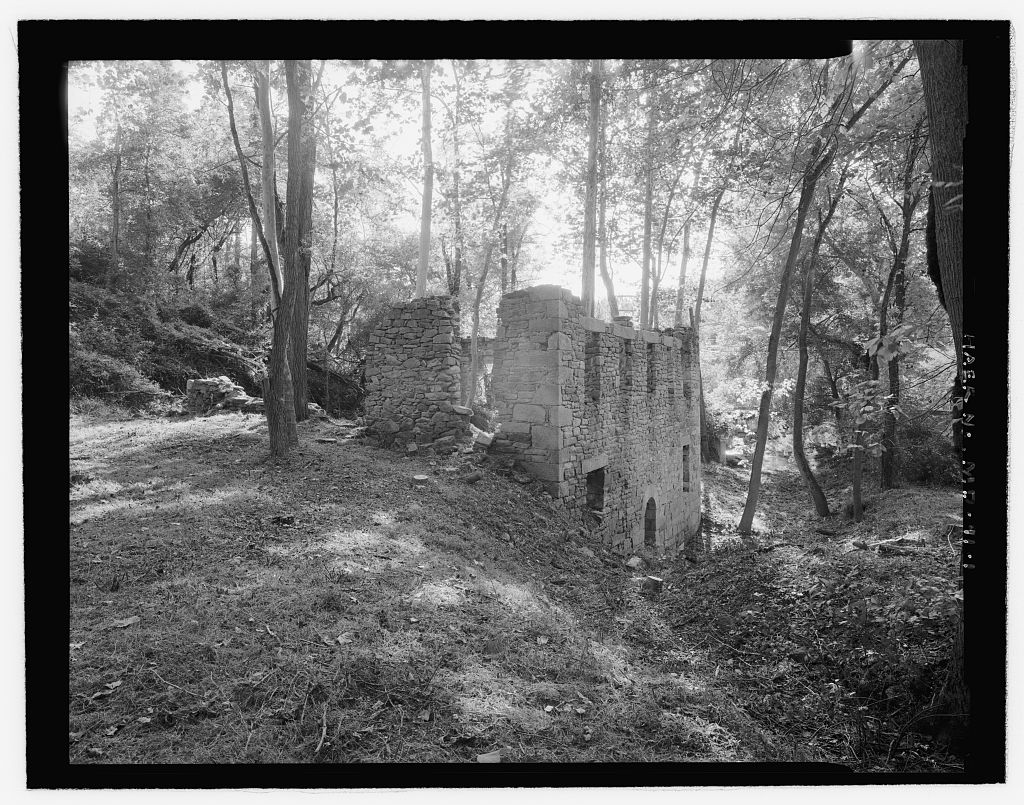
Simpsonville was a working community long before its name began turning up in local real estate conversations. The Maryland Archaeological Conservation Laboratory’s Simpsonville Mill summary describes it as a late 18th- through early 20th-century mill town in Howard County. Historic maps show a gristmill, woolen factory, sawmill, store, wheelwright shop, blacksmith shop, cemetery, and at least nine residences.
The Library of Congress record for Simpsonville Mill describes it as an important local industrial and commercial center. During the 19th century, the mill handled both textile work and flour milling. It also made cider until 1915, a wonderfully ordinary detail from a place now more likely to be described as a subdivision near Route 29.
When people talk about old Simpsonville, they are talking about a working landscape: roads, mills, stores, small homes, skilled trades, and the Middle Patuxent watershed. Much of that world is gone or hidden now, but the name still lingers in the geography around Cedar Lane, Guilford Road, Route 29, and the older residential pockets south of central Columbia.
Where Allview fits
Columbia was planned. Simpsonville evolved. Allview sits between those two stories. It was a planned postwar subdivision, but it grew out of a place that had already been on the map for generations.
The 1950s pitch: modern homes, country lots, no ground rent
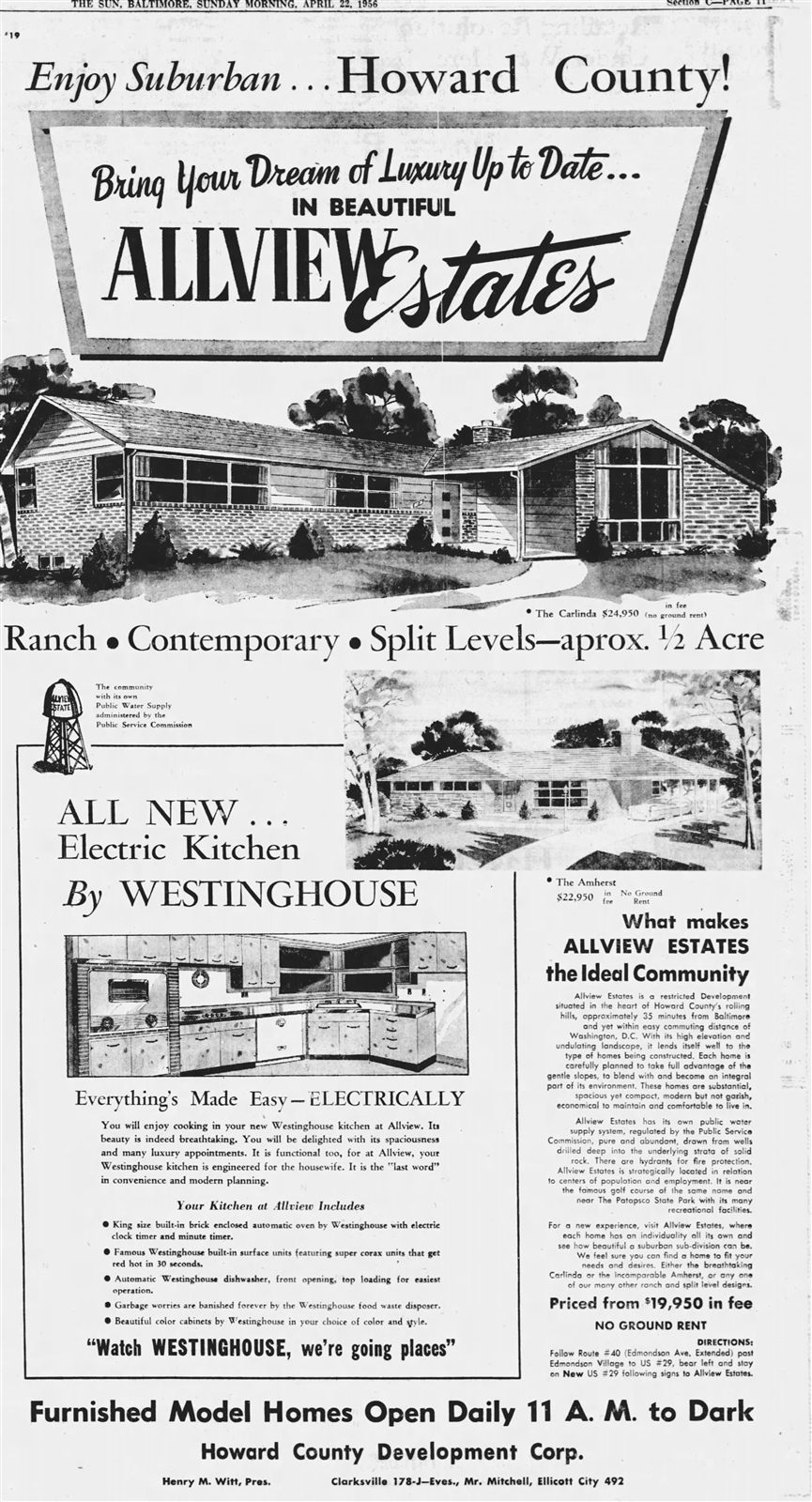
Newspaper advertisements show how the neighborhood was sold in the 1950s. An April 22, 1956 Baltimore Sun ad invited buyers to “Enjoy Suburban … Howard County!” and promoted Allview Estates as a restricted development with ranch, contemporary, and split-level homes on approximately half-acre lots.
The prices in that ad now look like they belong in a museum case: homes were promoted from $19,950, with larger models listed higher. The ad emphasized “no ground rent,” a public water supply, careful planning, generous landscaping, and model homes open daily. It also leaned hard into the 1950s dream of the electric kitchen, with Westinghouse appliances treated as a selling point almost as important as the lot itself.
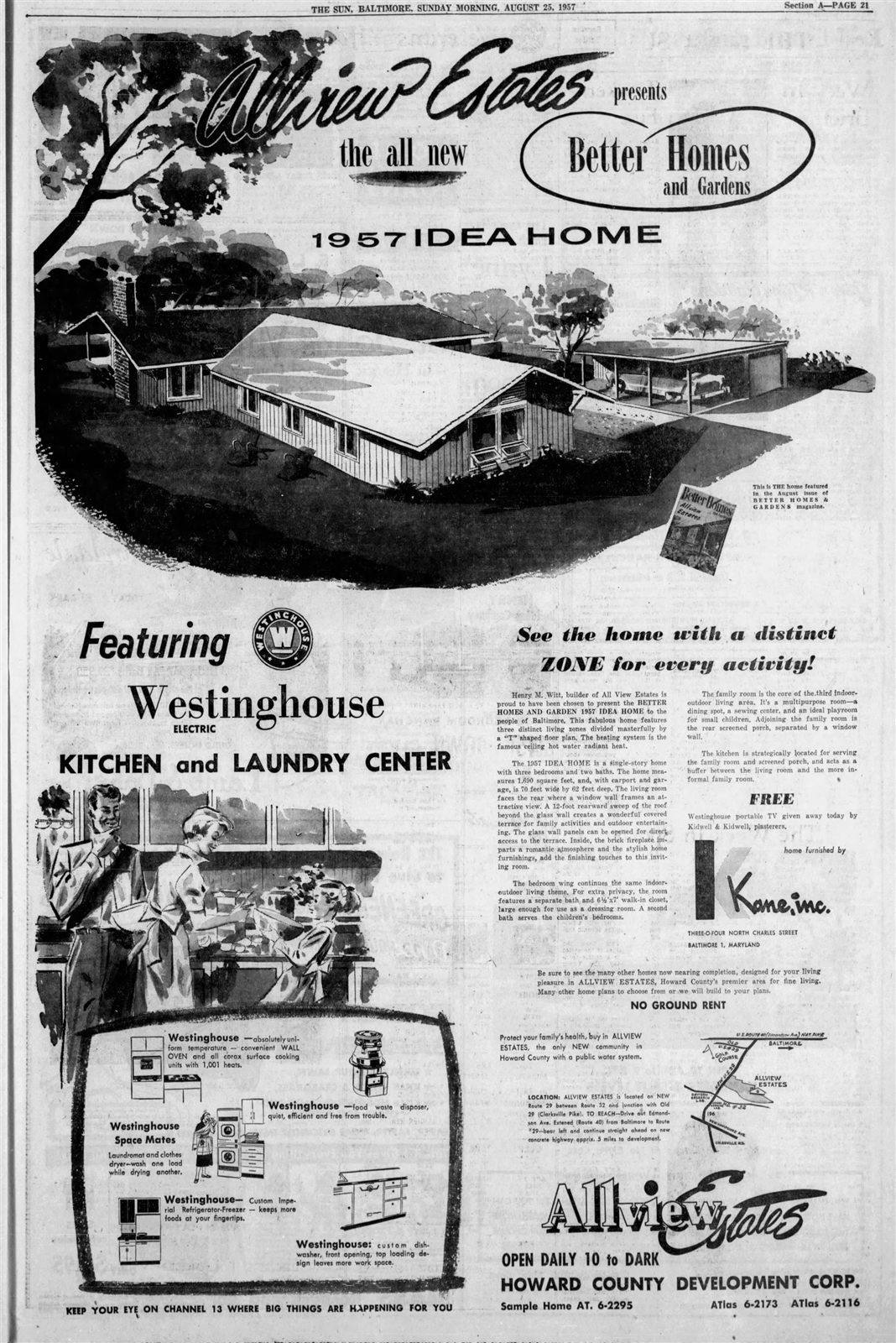
A 1957 Baltimore Sun ad went further, advertising a Better Homes and Gardens 1957 Idea Home in Allview Estates. The copy described the home as having indoor and outdoor “zones” for family life: a bedroom wing, family room, screened porch, indoor-outdoor living area, and a kitchen placed near the informal spaces. Even through the old newspaper scan, you can feel the larger sales pitch. Allview promised buyers a modern way to live, not merely a new house.
Allview was marketed as both convenient and separate. It sat near the new Route 29 and within commuting range of Baltimore and Washington, while promising trees, space, and houses with some individuality. More than half a century later, that combination still describes the neighborhood surprisingly well.
The water-system story: the part the ads did not linger on
The ads made Allview’s public water system sound like a major advantage. Later clippings show a bumpier reality.
A 1961 Baltimore Sun clipping reported that residents complained about “primitive” water service after a pump failure left some homes without water for several days. The article said the Allview area had about 150 homes at the time and that residents had to get emergency water from trucks while repairs were underway. It also identified the Wittco Water Company as the operator of two wells in the development.
By 1979, the water issue had become a health and infrastructure concern. An Evening Sun article by Nancy Minkoff reported that the Howard County health department planned blood tests for 385 Allview Estates families because residents were worried that acidic, corrosive water could contribute to copper and possible lead contamination from pipes and solder. The same article said officials were monitoring the situation and that children under 6 would be given priority for testing.
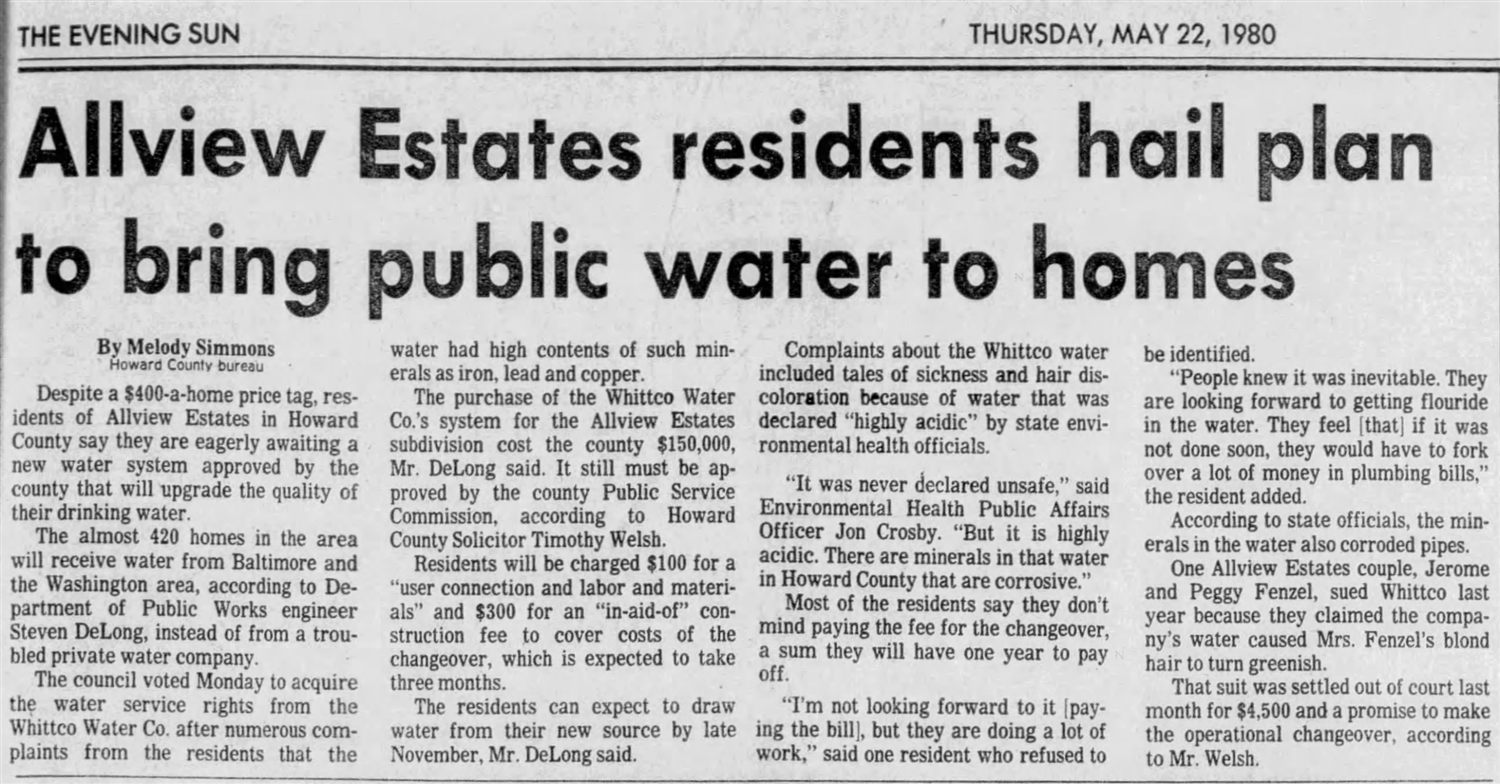
A 1980 Evening Sun article by Melody Simmons described residents awaiting a new county-approved water system. According to that article, nearly 420 homes were expected to receive water from Baltimore and the Washington area instead of from the troubled private company. The article said Howard County had voted to acquire service rights from Wittco Water Co., and it described complaints about mineral-heavy water, corrosion, staining, and even hair discoloration.
Water became a defining part of Allview’s history. The private system that separated the community from surrounding development also left residents wrestling with wells, pressure, minerals, corrosion, and service failures. The suburban promise in the old advertisements eventually ran into the far less glamorous business of maintaining pipes.
What the old ads and articles looked like
The early advertisements are full of confidence: electric kitchens, model homes, no ground rent, big lots, and modern family living. The later newspaper stories sound very different. They cover water problems, Columbia’s growth around older neighborhoods, and residents explaining why Allview still felt like its own place.
Of course, an old real estate ad is a sales pitch, not a neutral record. These ads are still useful evidence of what the developer believed buyers wanted in the 1950s: space, convenience, modern appliances, and suburban life without giving up the trees.
Then Columbia arrived around it
Columbia’s official timeline is well documented by the Columbia Association history page. James Rouse’s planned community was presented to Howard County officials in 1964, New Town zoning passed in 1965, construction began in 1966, and Columbia’s public beginning is generally tied to the 1967 dedication at Wilde Lake.
By then, Allview was already an established neighborhood.
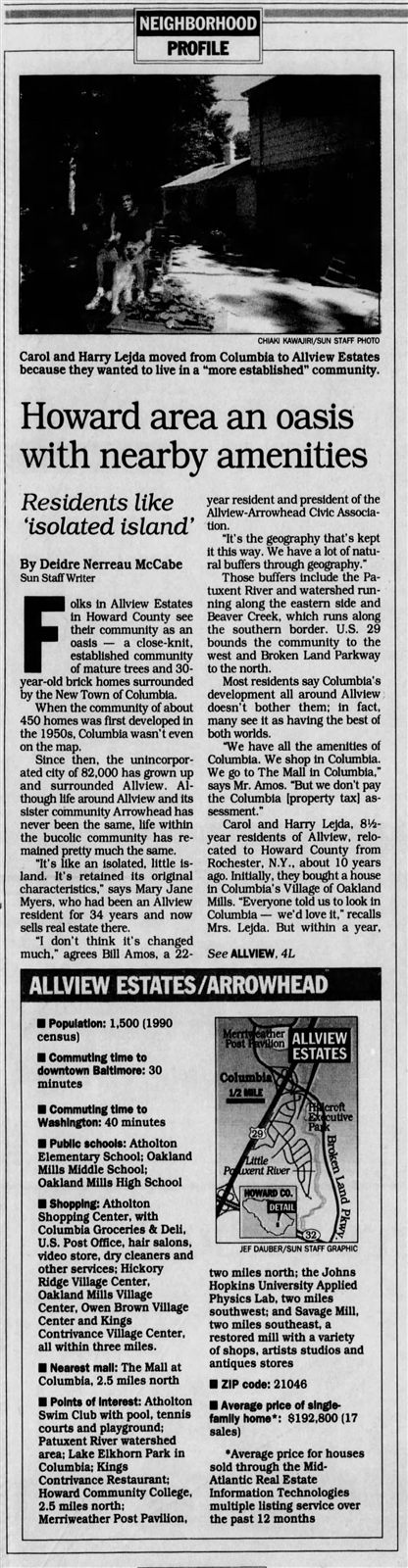
In later newspaper coverage, Allview is often described as an “outparcel,” meaning a residential pocket inside the broader Columbia map but outside the Columbia Association covenant and assessment structure. A 1995 Baltimore Sun neighborhood profile said the combined Allview Estates and Arrowhead area had about 450 homes and described residents as living in a close-knit, established community of mature trees and older brick houses surrounded by Columbia’s growth.
A 2002 Baltimore Sun article about Columbia outparcels described neighborhoods such as Donleigh, Arrowhead, and Allview Estates as places that feel close to Columbia without quite belonging to it. It noted practical differences that residents still recognize: greener street signs in the older neighborhoods, straighter roads, individual mailboxes, fewer sidewalks, and a different relationship to Columbia Association rules and fees.
If you have ever driven from a Columbia village road into one of these older pockets and felt the street rhythm change, that is not your imagination. The landscape is telling you which system came first.
The little shopping strip that still carries the Simpsonville name
There is one small commercial pocket that still feels especially important to the Allview story. It is not a Columbia village center. It is not a big shopping district. It is a strip mall, and in the most Allview way possible, it does a little bit of everything.
The businesses have changed over the years, but the current mix tells you a lot about how the neighborhood functions. There is a Dunkin’ nearby, a local pizza place, a liquor store, health-related offices and services, and Touché Touchet Bakery & Pastry Shoppe, which is one of those local bakeries people mention with real affection. It is the sort of place where a birthday cake, a box of pastries, or a holiday order becomes part of a family’s routine.
The most historically interesting tenant is the Simpsonville Post Office at 10400 Shaker Drive. In a neighborhood where the old Simpsonville name can feel buried under a Columbia address, the post office is a small surviving marker. “Simpsonville” remains in official use there, well beyond old maps and newspaper clippings.
That little strip also says something honest about daily life here. Allview is not a place where you can handle every errand inside the neighborhood. Residents leave for groceries, hospital care, most restaurants, shopping, entertainment, and county services. Home is quiet, wooded, and residential. Errands happen somewhere else.
Why Allview stayed Allview
Allview did not need to resist Columbia to keep its own personality. The neighborhood learned to live beside the new city while remaining recognizably itself.
Residents quoted in the 1995 profile liked the big lots, trees, privacy, and the sense of being in a quieter established neighborhood. The same article said many homeowners stayed for decades, expanded their houses, or moved within the community rather than leaving. It also noted that residents cultivated gardens and valued the lack of sidewalks and streetlights because those missing suburban features helped preserve the rural feel.
The 2012 Howard County Times article about retiring postal carrier Dan Fischer gives a gentler glimpse of that community culture. Fischer had delivered mail on the same Allview route for 40 years, serving about 370 homes. Residents gathered to say goodbye, a small detail that says a lot. In a neighborhood that sometimes gets defined by what it is not, not Columbia, not covenant-controlled, not a village in the usual Columbia sense, the article shows what it is: a place where people can know their mail carrier for decades.
There is a stubborn streak in Allview’s identity, grounded in old roads, mature trees, half-acre yards, individual mailboxes, and local memory. The neighborhood was here before the bigger story arrived, and it has never quite let anyone forget it.
Allview Estates and Simpsonville timeline
Late 1700s to early 1900s: Simpsonville Mill functions as part of a rural mill community in Howard County, with grist, textile, sawmill, store, trade, cemetery, and residential activity documented in historical and archaeological records. The mill also made cider until 1915.
1950s: Allview Estates is marketed as a modern Howard County suburban development with ranch, contemporary, and split-level homes on about half-acre lots.
1956: Baltimore Sun advertising promotes Allview Estates with public water, Westinghouse electric kitchens, model homes, no ground rent, and prices starting under $20,000.
1957: Allview promotes a Better Homes and Gardens 1957 Idea Home, reinforcing the neighborhood’s image as modern, planned, and family-oriented.
1961: A Baltimore Sun clipping reports water-service problems after a pump failure, with emergency water brought to residents.
1964 to 1967: Columbia is planned, zoned, built, and formally introduced, while Allview remains an older suburban pocket already on the ground.
1979 to 1980: Newspaper coverage focuses on Allview’s private water system, acidic water, copper and lead concerns, and the county’s move toward public water service.
1980s to 2000s: Allview is repeatedly described in press coverage as an independent neighborhood surrounded by Columbia but not fully part of Columbia’s covenant and assessment system.
Today: Allview remains one of the clearest examples of an older Howard County community living inside the orbit of Columbia while still keeping its own rhythm.
What to notice if you drive through today
You do not need a history degree to see the difference. Look for the larger lots, older ranch houses, straight streets, mature landscaping, and the feeling that the neighborhood was laid out before Columbia’s village system became the dominant local pattern. It feels less curated, and that is part of the appeal.
The surrounding area also connects naturally to RingJing’s guides to Maryland nature centers and easy kid-friendly hikes, Maryland hiking ideas, and fun facts about Maryland for kids. A drive through Allview makes more sense after you have seen how its roads, water, and neighborhood memory overlap.
Have an Allview memory or correction?
Local history gets better when people add porch-level details: old school bus stops, swim club memories, neighborhood events, street-name stories, photos, and corrections. You can send RingJing a local note and mention Allview in the message.
FAQ about Allview Estates history
Is Allview Estates part of Columbia?
It has a Columbia mailing address and is surrounded by Columbia, but historically Allview was developed before Columbia and is often described as an outparcel rather than a Columbia village neighborhood under the usual Columbia Association covenant structure.
Was Allview originally Simpsonville?
The area is tied to older Simpsonville, especially the Simpsonville Mill community near Cedar Lane and Guilford Road. Allview Estates itself was a 1950s suburban development that grew in the same broader part of Howard County before Columbia was built around it.
When was Allview Estates developed?
Newspaper ads show Allview Estates being actively marketed in the mid-1950s. Later neighborhood profiles describe most of the original homes as 1950s and early 1960s brick ranchers, split-levels, and Colonials.
Why does Allview feel different from nearby Columbia neighborhoods?
Allview has older roads, larger lots, individual mailboxes, mature trees, fewer sidewalks and streetlights, and a different relationship to Columbia Association rules and assessments. It grew before Columbia’s village model became the dominant local pattern.
Sources and notes
This history draws on local newspaper scans and public historical records. A few reduced archival scans are included above so readers can see the original advertisements and reporting. If you have cleaner scans, family photos, old neighborhood directories, or corrections, please send them along.
- Library of Congress: Simpsonville Mill, Historic American Engineering Record.
- Maryland Archaeological Conservation Laboratory: Simpsonville Mill site summary, 18HO80.
- Columbia Association: Columbia history timeline.
- Baltimore Sun advertisement, April 22, 1956: Allview Estates, Howard County Development Corp.
- Baltimore Sun advertisement, August 25, 1957: Allview Estates Better Homes and Gardens 1957 Idea Home.
- Baltimore Sun clipping, 1961: Allview Estates water-service problems.
- The Evening Sun, June 29, 1979: Nancy Minkoff, article on Allview Estates water testing concerns.
- The Evening Sun, May 22, 1980: Melody Simmons, article on public water plans for Allview Estates.
- The Baltimore Sun, September 10, 1995: Deirdre Nerreau McCabe, neighborhood profile of Allview Estates and Arrowhead.
- The Baltimore Sun, 2002: Laura Cadiz, article on Columbia outparcels and nearby non-CA neighborhoods.
- Howard County Times, May 3, 2012: Lindsey McPherson, article on retiring Allview postal carrier Dan Fischer.