If you are trying to feed a family in Central Maryland, produce can become the quiet grocery-budget problem. Nobody complains about buying apples or salad greens in the abstract. Then you look at the receipt and realize the berries had a full personality and a luxury tax.
This is the updated version of my old produce-shopping list. Some advice still holds up: buy what you will actually eat, watch freshness carefully, and do not assume that “cheap” means the same thing in every store. A warehouse case of oranges is a bargain only if your house can finish it before it turns into a science project.
The best answer is usually a mix. I would not use one source for everything. I would use a delivery box for convenience, Costco for planned bulk, international markets for variety, farmers markets for seasonal local food, and pick-your-own farms when you want the outing as much as the fruit.
Short version: where to start
| Best for | Where I would start | What to know |
|---|---|---|
| Convenience and less food waste | Hungry Harvest or another produce-box service | Good if you actually cook through the box. Check delivery area and skip/edit deadlines. |
| Bulk basics | Costco | Great for predictable staples, but only if you have storage and a plan. |
| Cheap herbs, greens, mushrooms, and specialty produce | International markets such as H Mart, Lotte Plaza, Great Wall, LA Mart, or Super Best | Selection can be excellent. Inspect freshness and plan to use delicate items quickly. |
| Large cases for sharing, freezing, or preserving | Jessup-area wholesale produce sources | Call ahead. Some sellers are friendlier to household buyers than others. |
| Local seasonal produce | CSA shares and farmers markets | Not always cheapest per pound, but often better quality and less waste if you cook seasonally. |
| A fruit outing | Larriland Farm and other pick-your-own farms | Fun and fresh. Not automatically cheap once you add time, gas, and enthusiastic children. |
1. Produce delivery boxes: convenient, but only if you use the box
Hungry Harvest is still one of the more recognizable produce-box options in Maryland. The appeal is simple: a box of fruits and vegetables shows up without a separate grocery trip, and you can usually adjust what is coming before delivery.
I would not describe every box as a magical bargain. The value depends on what you choose, whether you use the produce before it spoils, and whether the convenience saves you from a more expensive grocery run. Where it can work well is for families who want a steady push toward cooking vegetables during the week. A box on the porch has a way of asking, politely but firmly, “So, are we making soup or not?”
Best for: busy households, people who want variety, and families trying to reduce produce waste. Watch out for: delivery fees, skip deadlines, and the temptation to order aspirational vegetables that nobody in the house will touch.
2. Costco and warehouse stores: excellent if you shop with a plan
Warehouse stores are great for the produce your family eats every week without drama. At Costco, that might mean bananas, apples, berries, salad greens, frozen vegetables, avocados, citrus, or a bag of onions that looks like it was packed for a small restaurant.
The trick is being honest. Bulk produce is not automatically cheaper if half of it gets thrown out. I like warehouse shopping for foods with a clear plan: smoothie fruit, school-lunch apples, frozen vegetables, potatoes, onions, and sturdy greens. I am more cautious with giant clamshells of delicate berries unless we already know how they are getting used.
If you are weighing membership value, I wrote a separate Costco membership review for Howard County families. Produce is part of the equation, but the real value depends on your whole shopping pattern.
Best for: predictable staples, frozen produce, lunchbox fruit, and families with freezer space. Watch out for: overbuying, limited variety, and the “it was cheap, so I bought three” trap.
3. Asian and international markets: often the best variety for the money
If you live near Columbia, Ellicott City, Catonsville, Laurel, or Rockville, international markets can be a produce superpower. Stores such as H Mart, Lotte Plaza Market, Great Wall, LA Mart, Super Best, Patel Brothers, and other regional markets often carry herbs, greens, mushrooms, peppers, roots, tropical fruit, and specialty vegetables that are either expensive or absent at a conventional supermarket.
This is where I usually look for scallions, cilantro, napa cabbage, bok choy, mushrooms, eggplant, ginger, Asian pears, mangoes, and ingredients for stir-fries or soups. The prices can be excellent, but freshness varies by item and by day. Do not shop on autopilot. Pick things up, look at the stems, check the bottoms of berry containers, and be realistic about how fast you need to cook them.
Best for: herbs, greens, mushrooms, peppers, specialty fruit, and cooking projects that need more than supermarket basics. Watch out for: delicate produce near the end of its shelf life. Sometimes the bargain is real. Sometimes the clock is just louder.
4. Wholesale produce in Jessup: useful if you can handle cases
The Jessup area is home to a major food distribution hub, which is why older Maryland families sometimes talk about buying produce “where the restaurants buy it.” The idea can work, but this is not the same as walking into a grocery store for three peaches and a head of lettuce.
If you are buying by the case for a party, a large household, a canning/freezing project, a school event, or a group of neighbors splitting the order, wholesale produce can make sense. Call ahead, ask whether household buyers are welcome, ask about payment, and confirm pickup rules before driving over. Some vendors are set up for retail-friendly service. Others are primarily built for restaurants and commercial accounts.
One long-running local option is Class Produce, which has historically been more approachable for advance household orders than the true wholesale market experience. Still, do not wing it. Ask for a current list, pricing, minimums, and pickup instructions.
Best for: cases of fruit, bulk vegetables for events, families splitting an order, freezing, preserving, and meal-prep projects. Watch out for: minimums, pickup logistics, and buying more than your kitchen can absorb.
5. CSA farm shares: not always cheapest, often the freshest
A CSA, or community supported agriculture share, is not exactly a grocery discount program. You are buying into a farm season. The reward is fresh local produce and a closer relationship with the farms feeding the region. The tradeoff is that you need to cook with what is in season, and you usually sign up before the season is fully underway.
Gorman Farms CSA, near the Columbia/Laurel area, remains one of the better-known local examples. Their CSA program is the kind of option that can be wonderful for a household that likes cooking, salads, roasted vegetables, herbs, and seasonal surprises.
A CSA is less ideal if your family needs absolute predictability or rejects unfamiliar vegetables with theatrical force. If you have ever watched a child negotiate with a turnip like it was a hostile witness, you know what I mean.
Best for: seasonal cooks, local-food supporters, and families willing to learn a few new recipes. Watch out for: signup windows, pickup rules, vacation weeks, and vegetable fatigue in peak season.
6. Farmers markets: best for seasonal quality, conversation, and local farms
Howard County has a producer-focused farmers market scene, and the Howard County Farmers Markets site is the first place I would check for seasonal locations and hours. Market pages change, and some season pages lag, so verify the current day, time, and location before you load everyone into the car.
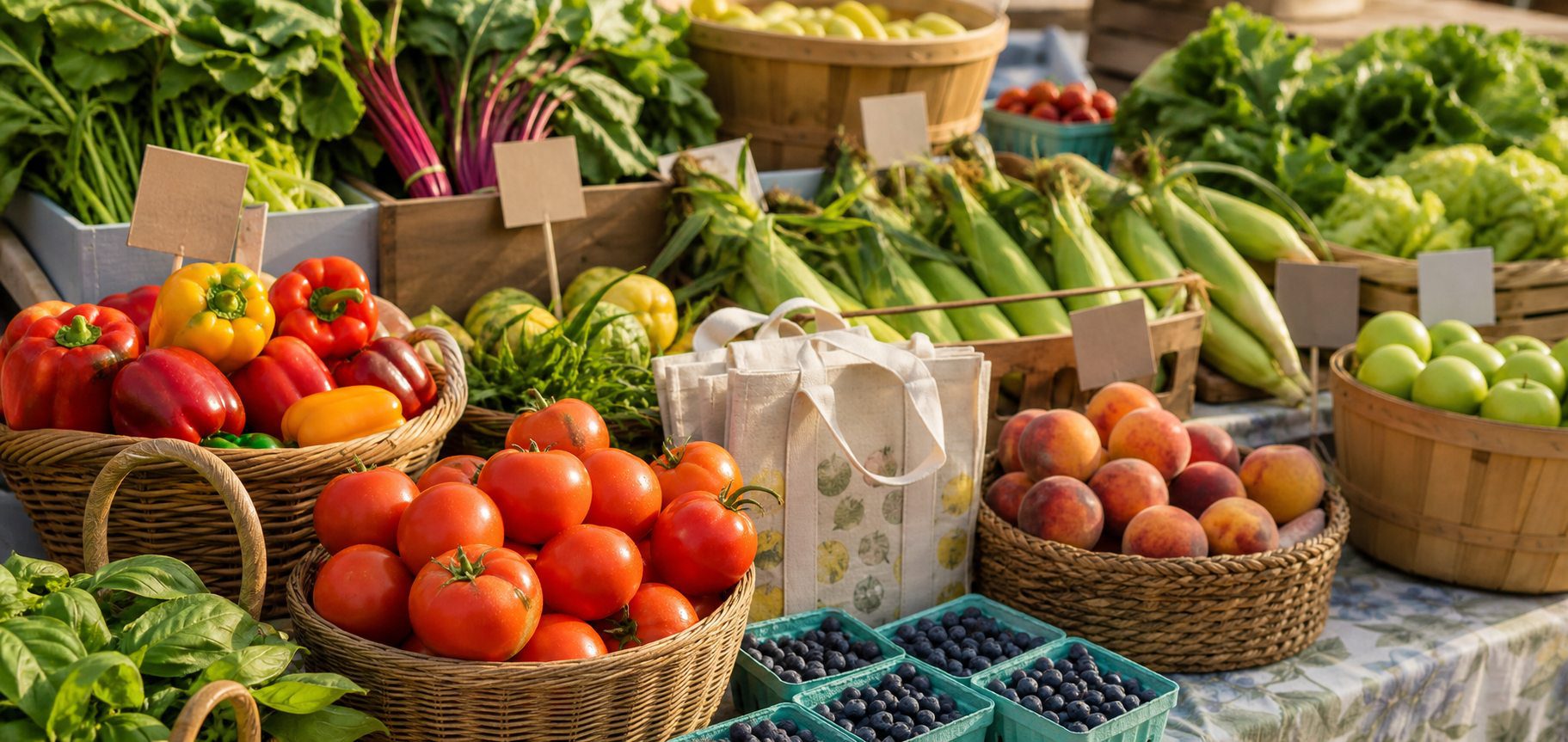
Farmers markets are not always the cheapest option by weight. That is the wrong comparison for some items. The value is freshness, flavor, local farm support, and the ability to ask the grower directly about varieties, growing practices, storage, and how to cook the thing you just bought because it looked cheerful in a pile.
There is also a practical budget angle: when produce tastes better, you are more likely to eat it. A $4 tomato that actually becomes lunch is cheaper than a cheaper tomato that sits on the counter judging everyone until it collapses.
Best for: tomatoes, peaches, greens, herbs, eggs, local fruit, farm conversations, and weekend food routines. Watch out for: limited hours, weather, parking, and the fact that not every vendor takes every payment method.
7. Pick-your-own farms: fresh, memorable, and not always cheaper
Larriland Farm in western Howard County is one of the classic local pick-your-own options. Depending on the season, you may find strawberries, blueberries, raspberries, blackberries, peaches, apples, pumpkins, greens, and other crops. The important phrase is “depending on the season.” Always check the farm’s current harvest page before going.
Pick-your-own can be a bargain when you pick carefully, use what you bring home, and treat the trip as both food shopping and family activity. It becomes less cheap when everyone is hot, hungry, and emotionally committed to filling the largest container available.
That does not mean it is not worth it. It just means the math is different. You are buying fruit, fresh air, a memory, and possibly a reminder that small children are astonishingly confident fruit inspectors.
Best for: seasonal fruit, family outings, freezing berries, applesauce, jam, and kids who need to see where food comes from. Watch out for: weather, crop availability, field conditions, and overpicking.
My practical produce strategy
If I were trying to keep produce costs reasonable in Howard County or Central Maryland, I would use this mix:
- Weekly basics: Costco, Lidl, Aldi, or a regular grocery store sale.
- Flavor and variety: international markets.
- Local peak-season food: farmers markets and occasional farm stands.
- Big projects: wholesale cases or pick-your-own farms.
- Convenience: a produce box only if your household consistently uses it.
How to waste less produce once you buy it
The cheapest produce is the produce you actually eat. A few small habits help more than any one perfect store:
- Wash berries only when you are ready to use them unless you have a drying/storage routine that works.
- Freeze bananas, berries, spinach, and chopped peppers before they pass the point of no return.
- Keep a “use this first” bin in the fridge.
- Turn tired vegetables into soup, stir-fry, fried rice, frittata, or roasted vegetables.
- Do not buy five hopeful vegetables in the same trip unless you have five actual plans.
Useful kitchen tools, without turning this into a gadget parade
You do not need a new appliance to eat more produce. A sharp knife, a cutting board, a sheet pan, and a freezer bag will do a lot. If you cook produce often, a few tools can help: a salad spinner, a good blender for smoothies or soups, a pressure cooker for beans and stews, a vegetable peeler, and containers that make leftovers visible.
The real tool is a plan. If the plan is “future me will become a weekday salad person,” future you may have some feedback.
Frequently asked questions
What is the cheapest place to buy produce in Central Maryland?
There is no single winner. International markets are often excellent for herbs, greens, mushrooms, and specialty produce. Costco can be strong for bulk staples. Farmers markets and CSAs can be better for seasonal quality. Wholesale cases can be cheapest per pound only when you can use or split the volume.
Are farmers markets cheaper than grocery stores?
Sometimes, but not always. Farmers markets are often a better value for freshness, flavor, and local food than for rock-bottom pricing. The best deals tend to be seasonal items at peak supply, especially if you are flexible.
Is a CSA worth it for a family?
A CSA can be worth it if your family cooks regularly and is willing to use seasonal produce. It is less ideal if you need predictable grocery-store choices every week or travel often during the pickup season.
Is pick-your-own fruit cheaper?
It can be, especially for berries or fruit you plan to freeze or preserve. But pick-your-own is also an outing, so include time, gas, weather, and how much your family is likely to pick once everyone is in the field.