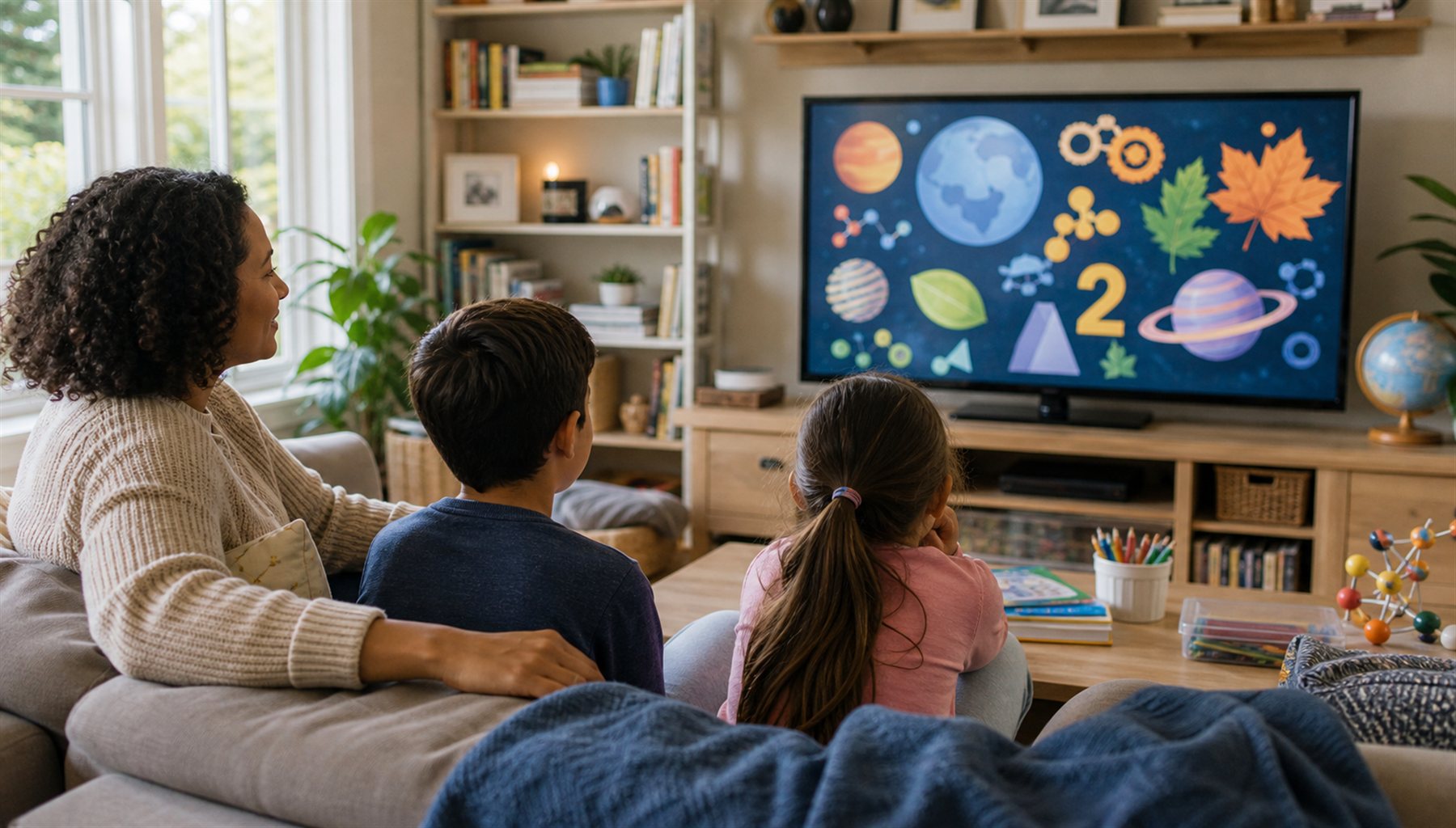
Not every minute in front of a screen needs to become a lesson plan. Sometimes a parent needs to make dinner, answer an email, or sit quietly for twenty minutes. Still, when a show can make a child laugh and leave behind a useful idea about numbers, animals, feelings, history, or engineering, that is a pretty good bargain.
This is a shorter and more selective guide than the enormous streaming lists scattered around the internet. These programs are here because they teach something clearly, respect children’s intelligence, and are entertaining enough that watching them does not feel like swallowing a worksheet.
A note about streaming availability
Streaming catalogs change constantly and can differ by country, subscription, and season. Rather than promise that a show will remain on one service, this guide links to official show pages, PBS KIDS video pages, Netflix listings, or verified creator channels. Some episodes are free; others require a subscription or purchase.
Official links and availability pages were checked July 3, 2026. A few older PBS shows now use archived PBS KIDS links because the original pages are not consistently available. Preview any unfamiliar program yourself; age suggestions are starting points, not guarantees.
Quick picks by interest
| Your child likes… | Start with… |
|---|---|
| Letters and early reading | Super Why!, WordWorld, Sesame Street, Storyline Online |
| Vocabulary and wordplay | Martha Speaks, WordWorld, Molly of Denali |
| Numbers and math | Peg + Cat, Work It Out Wombats!, Odd Squad, Cyberchase |
| Animals and nature | Wild Kratts, Elinor Wonders Why, National Geographic Kids |
| Experiments and engineering | The Magic School Bus Rides Again, Ada Twist, Scientist, Design Squad |
| Feelings and social skills | Daniel Tiger’s Neighborhood, Sesame Street |
| Fast science explanations | SciShow Kids, Crash Course Kids, TED-Ed |
Best educational shows for preschoolers
1. Sesame Street
Sesame Street has lasted because it understands that young children learn through repetition, music, humor, and relationships. Letters and numbers are only part of it. The show also covers patience, grief, empathy, family differences, and the awkward business of getting along with other people.
Best for: Roughly ages 2–5. What it teaches: Early literacy, numeracy, emotions, health, and community.
Parent note: The short segments work well for children who are not ready to follow a long story. Sesame Workshop’s official page is also a useful doorway to family resources beyond the show.
2. Daniel Tiger’s Neighborhood
Daniel Tiger’s Neighborhood is at its best when a child is facing an ordinary but enormous preschool problem: a parent leaves, a friend will not share, the doctor is scary, or disappointment has ruined the universe. Its little songs are designed to be reused in real life, and irritatingly enough, many of them work.
Best for: Ages 2–5. What it teaches: Emotional regulation, routines, friendship, and communication.
3. Super Why!
Super Why! turns letters, spelling, and story comprehension into superhero tools. It is very direct about its educational purpose, which can be helpful for children beginning to connect spoken words with print.
Best for: Ages 3–6. What it teaches: Letter recognition, phonics, vocabulary, and reading comprehension.
4. WordWorld
WordWorld is a wonderfully literal reading show: objects are built out of the letters that spell them. A barn is made of the letters B-A-R-N. A dog is made of D-O-G. For children who are starting to understand that letters make words and words name real things, that visual trick can be surprisingly powerful.
Best for: Ages 3-6. What it teaches: Letter recognition, word building, phonics, vocabulary, and early spelling. Availability note: The original PBS KIDS page is no longer consistently available, so the link above points to an archived PBS KIDS page.
5. Peg + Cat
Peg + Cat sneaks math into comic adventures without making every problem look like a row of flash cards. Children encounter counting, patterns, measurement, shapes, and spatial thinking while Peg tries to solve a very big problem without panicking too much.
Best for: Ages 3–6. What it teaches: Early math and persistence.
6. Elinor Wonders Why
Elinor Wonders Why is built around a habit worth encouraging: notice something, ask a question, and investigate instead of guessing. The nature observations are gentle and accessible, whether Elinor is wondering how animals stay cool or why certain plants grow where they do.
Best for: Ages 3–6. What it teaches: Observation, life science, curiosity, and evidence-based thinking.
7. Work It Out Wombats!
Work It Out Wombats! introduces the kind of thinking behind computer science without putting preschoolers in front of code. Characters break problems into steps, recognize patterns, test plans, and revise them when the first idea fails.
Best for: Ages 3–6. What it teaches: Sequencing, patterns, problem solving, and flexible thinking.
Best educational shows for early elementary children
8. Wild Kratts
Wild Kratts is an easy recommendation for children who collect animal facts faster than adults can remember them. The animated adventures are energetic, but the creature abilities are grounded in real adaptations and habitats. A child may arrive for the superpowers and stay for the zoology.
Best for: Ages 5–9. What it teaches: Animal science, habitats, adaptations, and conservation.
9. Odd Squad
Odd Squad wraps math in a wonderfully strange live-action agency where children investigate cases adults apparently cannot handle. Patterns, fractions, measurement, geometry, and logical reasoning become tools for solving mysteries.
Best for: Ages 5–9. What it teaches: Math, logic, collaboration, and explaining a solution.
10. Molly of Denali
Molly of Denali follows an Alaska Native girl who uses maps, schedules, websites, diagrams, interviews, and community knowledge to solve practical problems. It is a rare children’s show that treats finding and evaluating information as an adventure in itself.
Best for: Ages 5–9. What it teaches: Informational literacy, culture, geography, and community.
11. Martha Speaks
Martha Speaks has one of the better educational premises for vocabulary: Martha is a dog who starts talking after alphabet soup gives her words, and the show uses that setup to make new language feel funny instead of formal. It is especially good for children who are ready for richer words but still want a story with jokes, pets, and ordinary kid problems.
Best for: Ages 4-8. What it teaches: Vocabulary, word meanings, context clues, expressive language, and story comprehension. Availability note: The original PBS KIDS page is no longer consistently available, so the link above points to an archived PBS KIDS page.
12. Ask the StoryBots
Ask the StoryBots starts with the questions children actually ask: Why is the sky blue? How do people catch a cold? Why do we need to brush our teeth? The answers are fast, musical, silly, and usually much more detailed than the average grown-up improvisation.
Best for: Ages 4–8. What it teaches: General science, the human body, technology, and everyday “why” questions. Where to look: Netflix.
13. The Magic School Bus Rides Again
The Magic School Bus Rides Again updates the familiar formula: impossible field trip, scientific problem, mild chaos, and a classroom that returns with considerably more firsthand experience than the permission slip suggested. It is broad rather than deep, but excellent for sparking questions.
Best for: Ages 5–9. What it teaches: Earth science, biology, physics, space, and scientific curiosity. Where to look: Netflix.
14. Ada Twist, Scientist
Ada Twist, Scientist emphasizes the process of science more than memorizing facts. Ada asks questions, forms ideas, tests them, makes mistakes, and tries again with friends whose strengths include engineering and architecture.
Best for: Ages 4–8. What it teaches: Hypotheses, experiments, teamwork, and persistence. Where to look: Netflix.
Best educational shows and channels for older elementary children
15. Cyberchase
Cyberchase puts math inside longer adventures involving codes, maps, probability, data, and strategy. The animation shows its age more than some newer programs, but the mathematical reasoning remains useful.
Best for: Ages 7–11. What it teaches: Applied math, logic, data, and problem solving.
16. Design Squad
Design Squad is one of the better choices for a child who wants to build instead of merely watch. Young people work through engineering challenges, create prototypes, discover why something failed, and improve it. The failures are often the most educational part.
Best for: Ages 8–12. What it teaches: Engineering design, measurement, teamwork, and iteration.
17. SciGirls
SciGirls centers real girls using science and engineering to investigate meaningful questions. It is especially valuable because children see the decisions, data collection, uncertainty, and collaboration behind a project, not just a polished answer at the end.
Best for: Ages 8–12. What it teaches: STEM practices, teamwork, role models, and real-world investigation.
18. SciShow Kids
SciShow Kids offers short videos about animals, weather, space, plants, the body, and experiments. It is useful when a child has one specific question and a family does not need a full episode built around it.
Best for: Ages 5–10. What it teaches: Broad science concepts and vocabulary. Parent note: Use the official channel rather than letting recommendations wander after the video ends.
19. Crash Course Kids
Crash Course Kids moves faster and packs in more terminology than most children’s shows. The videos are strongest for upper-elementary students reviewing a school topic such as food chains, engineering, gravity, or Earth’s systems.
Best for: Ages 9–12. What it teaches: Elementary and middle-grade science. Parent note: Pause when needed; speed is not the same thing as understanding.
20. National Geographic Kids
National Geographic Kids is a good source for short animal, geography, culture, and exploration videos. It works particularly well for children whose curiosity arrives in bursts rather than thirty-minute episodes.
Best for: Ages 6–12. What it teaches: Animals, habitats, geography, and world cultures.
21. TED-Ed
TED-Ed covers everything from mythology and language to math puzzles and medical science. The animation is polished, but the vocabulary and subject matter vary widely. Choose individual videos rather than treating the entire channel as one age level.
Best for: Ages 10 and up, depending on the video. What it teaches: Science, history, literature, critical thinking, and big questions.
22. It’s Okay to Be Smart
It’s Okay to Be Smart explores science questions with enough depth to interest teens and curious adults, while remaining approachable for many older elementary students. Topics range from evolution and astronomy to perception and climate.
Best for: Ages 10 and up. What it teaches: Science, evidence, and how scientists frame questions.
A useful reading option that happens to be on a screen
Storyline Online
Storyline Online features actors reading illustrated children’s books aloud. It is not a substitute for reading together, but it can introduce new authors, model expressive reading, and give a child a story when the available grown-up is temporarily occupied with something less enchanting, such as cleaning the kitchen.
How to make educational screen time more useful
- Choose the episode, not just the brand. Even a strong series has episodes that fit your child better than others.
- Ask one real question afterward. “What surprised you?” works better than a quiz about five facts.
- Connect it to something physical. Draw the animal, build the bridge, find the shape, look for the moon, or test whether the paper airplane idea works.
- Turn off autoplay when possible. A deliberate ending makes it easier to move from watching to doing.
- Watch unfamiliar YouTube content nearby. Official channels help, but recommendations, ads, comments, and linked videos can move children away from the material you selected.
- Do not oversell it. A funny science show can be worthwhile without counting as an entire science curriculum.
Take the idea away from the television
When a show sparks a bigger interest, RingJing’s guide to Maryland homeschool field trips and educational day trips includes science centers, nature programs, museums, historical sites, and free resources for families.
Frequently asked questions
What are the best educational TV shows for preschoolers?
Sesame Street, Daniel Tiger’s Neighborhood, Super Why!, WordWorld, Peg + Cat, Elinor Wonders Why, and Work It Out Wombats! are strong starting points. The best choice depends on whether the child needs support with literacy, math, science curiosity, routines, or emotions.
What are good educational science shows for kids?
Wild Kratts, Ask the StoryBots, The Magic School Bus Rides Again, Ada Twist, Scientist, SciGirls, SciShow Kids, Crash Course Kids, and It’s Okay to Be Smart cover science at different ages and levels of depth.
Are there free educational shows for children?
Yes. PBS KIDS publishes free videos from many of its programs, and official YouTube channels such as SciShow Kids, Crash Course Kids, National Geographic Kids, TED-Ed, and Storyline Online offer free viewing. Availability and advertising can change.
Is YouTube safe for educational screen time?
YouTube can contain excellent educational material, but parents should select official channels, review unfamiliar videos, manage autoplay and recommendations, and use supervised or restricted experiences appropriate to the child’s age.
How much educational TV should a child watch?
A program’s educational value does not remove the need for sleep, movement, conversation, creative play, reading, and hands-on experience. Families should use current pediatric guidance and make a realistic plan based on the child’s age, needs, and the quality and context of the media.
Does watching educational television count as learning?
It can support learning by introducing vocabulary, ideas, questions, and role models. Children generally gain more when an adult occasionally watches with them, discusses what happened, or connects the program to reading, play, an experiment, or a real-world outing.