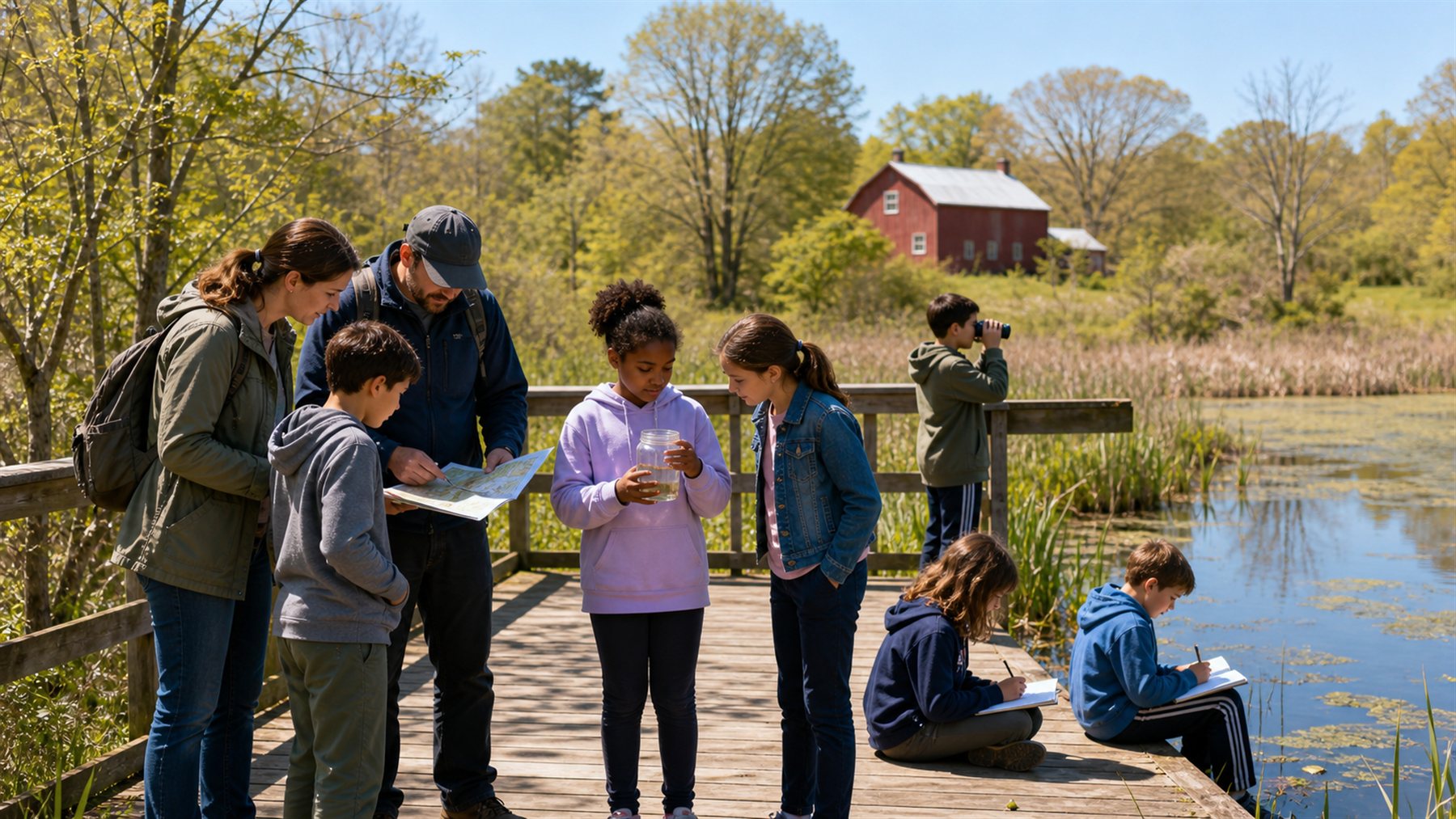
Maryland is unusually good territory for homeschool field trips. In one school week, a family can study cryptography at an intelligence museum, test marsh water beside the Patuxent River, climb through railroad history, and stand where the national anthem began.
The harder part is figuring out which places actually welcome homeschoolers in an organized way. Museum pages move. Programs disappear between semesters. A “school field trip” may require 15 students, while a “homeschool day” may sell out before you hear about it.
This guide separates the dependable options from the possibilities. The first section covers places currently advertising homeschool-specific programming. The rest are excellent educational trips, but you may need a co-op, a group reservation, or your own plan for turning the visit into a lesson.
A quick note before you make plans
“Homeschool program” can mean a one-day event, a semester club, a class series, or ordinary school-group programming that accepts co-ops. Check the current age range, minimum enrollment, adult-to-child ratio, cancellation policy, and whether siblings can attend. Program calendars often change seasonally.
Links and program descriptions were checked against official websites on June 12, 2026. This article was published May 12, 2026 and updated during final fact-checking.
Jump to a section
Maryland places with current homeschool-specific programs
Start here if you want a program built for homeschool families rather than a lesson plan you invent in the parking lot.
1. Maryland Science Center — Baltimore
The Maryland Science Center’s homeschool program page is the right bookmark for scheduled science sessions, labs, and registration details. Pair a program with the permanent exhibits, planetarium, or an IMAX film and you have an easy full-day trip. Read the age bands carefully; the best session for a first grader is rarely the best session for a middle schooler.
2. Earth Friends at Irvine Nature Center — Owings Mills
Earth Friends Homeschool is Irvine Nature Center’s outdoor homeschool option. Irvine is a particularly good fit for families who want repeated nature study rather than a single field trip. Expect mud, weather, animal encounters, and the sort of observations that do not happen through a worksheet.
3. Eco Explorers Homeschool Club — Howard County Conservancy
The Eco Explorers Homeschool Club currently advertises a monthly outdoor series for children in kindergarten through second grade at Belmont Historic Park in Elkridge. The narrow age range is worth noticing before you promise older siblings a spot. For younger children, though, a recurring club can build confidence and familiarity in a way that one-off programs do not.
4. B&O Railroad Museum homeschool programs — Baltimore
The B&O Railroad Museum homeschool page lists opportunities designed for home-educated students and families. Transportation history gives you plenty of directions to follow: engineering, westward expansion, labor, communication, geography, and the growth of Baltimore. Leave time for children to simply look at the locomotives. Not every minute has to become an assignment.
5. Baltimore Museum of Industry Homeschool Days — Baltimore
The Baltimore Museum of Industry runs Homeschool Days built around Maryland industry, invention, engineering, and work. This is one of the better choices for a child who asks how ordinary things are made. The museum’s recreated workspaces also give adults plenty to talk about: jobs that vanished, technology that replaced them, and the industries that shaped Baltimore neighborhoods.
6. National Aquarium homeschool programs — Baltimore
The National Aquarium education page includes themed homeschool experiences alongside its broader field-trip offerings. These programs can sell quickly, so join the education mailing list or check the page before building the semester calendar. Even without a special session, the Aquarium supports strong lessons in habitats, food webs, adaptation, climate, and conservation.
Excellent trips for homeschool co-ops and organized groups
These organizations have substantial education programs, but an individual family should not assume it can book the same experience offered to a class. Ask about minimum group size, co-op eligibility, grade bands, available dates, deposits, and whether adults pay separately.
Jug Bay Wetlands Sanctuary — Lothian
Jug Bay’s education programs use the marsh, forest, and Patuxent River watershed as the classroom. Water-quality testing, wetland ecology, and wildlife observation are natural fits. For an individual visit, walk the boardwalks and bring a short species list rather than trying to identify everything alive before lunch.
Hard Bargain Farm — Accokeek
The Alice Ferguson Foundation operates environmental education at Hard Bargain Farm. Its school programs connect watershed science, agriculture, and outdoor field study. Families can also watch for public and community programs. This is a good place to discuss where food comes from without pretending every child will enjoy the smell of a working farm.
Accokeek Foundation at Piscataway Park — Accokeek
The Accokeek Foundation brings together Indigenous history, colonial history, agriculture, conservation, and the Potomac landscape. Check the current calendar and group offerings rather than relying on an old program name. A visit works best when you leave room for the uncomfortable parts of history instead of reducing the trip to farm animals and costumes.
Wilma Lee education trips — Annapolis Maritime Museum
The Annapolis Maritime Museum’s Wilma Lee education program currently welcomes school groups, scout troops, homeschool co-ops, and other youth groups, generally beginning at fifth grade. Students can work with water-quality data, oysters, navigation, and Chesapeake history aboard a historic skipjack. This is not a casual drop-in activity; organize the group first.
Robinson Nature Center — Columbia
Robinson Nature Center is convenient for Howard County families and has public programs, exhibits, trails, and school-oriented environmental education. The planetarium and children’s discovery room can rescue a rainy nature day. Check the county registration calendar for the current schedule rather than expecting a standing homeschool class. Robinson and the Howard County Conservancy also appear in RingJing’s guide to nature and activity birthday parties in Howard County.
Maryland Hall classes — Annapolis
Maryland Hall is useful when “field trip” really means sustained arts instruction. Its class catalog may include visual art, ceramics, dance, music, and theater for different ages. These are public classes rather than a single permanent homeschool program, so schedules and daytime availability change.
Freetown Farm — Columbia
Freetown Farm connects agriculture, ecology, food access, and community. Watch for family programs and volunteer opportunities. Before bringing a group, ask what work is age-appropriate and whether the day is an educational program, a volunteer shift, or both.
Strong self-guided homeschool day trips in Maryland
A good field trip does not require a laminated packet. Pick one question before you leave, let the place do most of the teaching, and talk about the question on the way home.
National Cryptologic Museum — Fort Meade
The National Cryptologic Museum is one of Maryland’s most distinctive free educational stops. Use it for codes, cybersecurity, mathematics, linguistics, military history, and the ethics of intelligence work. Check current identification, security, and operating requirements before driving to Fort Meade.
Patapsco Valley State Park — Central Maryland
Patapsco Valley State Park can support geology, river ecology, engineering, local industry, and simple outdoor observation. Choose one park area rather than trying to “do Patapsco.” The park stretches for miles, and the entrances do not all connect by road.
Assateague Island National Seashore — Eastern Shore
At Assateague Island, the ponies get the attention, but the barrier-island ecology is the real curriculum. Study dunes, salt marshes, coastal change, wildlife management, and human impact. Keep the required distance from the horses; they are wild animals, not field-trip props.
Fort McHenry — Baltimore
Fort McHenry makes the War of 1812 and the national anthem tangible. Before visiting, read the lyrics beyond the first verse and discuss who was included in the country’s promises at the time. National Park Service Junior Ranger materials can give younger students a manageable purpose while exploring.
Antietam National Battlefield — Sharpsburg
Antietam is a serious place. It works best with preparation, especially for younger students. Focus on a few people, locations, or decisions rather than drowning everyone in troop movements. Leave time to reflect on the human cost of the battle.
Harriet Tubman Underground Railroad National Historical Park — Church Creek
The Harriet Tubman visitor center and landscape are worth the drive. Combine the exhibits with nearby sites on the Harriet Tubman Underground Railroad Byway, but resist turning the day into a scavenger hunt. The geography matters because the danger, distance, weather, and waterways mattered.
The Walters Art Museum — Baltimore
The Walters offers free general admission and collections spanning thousands of years. Give each child one job: find the strangest animal, the most useful object, or a portrait that raises a question. Ten deeply observed works beat 200 rooms walked at top speed.
Baltimore Museum of Industry — Baltimore
Even outside a Homeschool Day, the BMI is an excellent self-guided stop for manufacturing, labor, immigration, design, and the history of everyday products. Ask children to choose one modern object and trace how many jobs and machines were needed to create it.
Chesapeake Bay Maritime Museum — St. Michaels
The Chesapeake Bay Maritime Museum combines boats, a working shipyard, fisheries, navigation, ecology, and Chesapeake communities. It is a long day from Central Maryland, so pair it with one clear theme instead of trying to absorb the entire campus.
Brookside Gardens — Wheaton
Brookside Gardens is a flexible, lower-pressure trip for botany, pollinators, landscape design, seasons, and nature journaling. It is also a good answer when the family needs a learning day that does not feel like an Event.
Button Farm Living History Center — Germantown
Button Farm interprets slavery, resistance, emancipation, and Black history in Maryland. Visit through a scheduled public event or arranged program rather than assuming daily museum hours. Prepare children for the subject honestly and at an age-appropriate level.
Port Discovery and the Maryland Zoo — Baltimore
Port Discovery works best for younger children who learn through movement, building, and imaginative play. The Maryland Zoo supports animal behavior, habitats, conservation, and observational drawing. Neither visit needs a five-page worksheet to count as school.
Tracks and Yaks railbikes — Frostburg
Tracks and Yaks is more adventure than formal lesson, but the route opens conversations about rail engineering, Appalachian geography, tunnels, grades, and transportation history. Check rider requirements, weather policies, and the actual route before making the long drive west.
How to make a homeschool field trip better
- Choose one question. “How does a wetland clean water?” is better than “learn everything about wetlands.”
- Check the practical details yourself. Confirm hours, admission, parking, food rules, accessibility, age limits, and whether the program requires a group.
- Prepare lightly. A short video, map, picture book, or vocabulary list is usually enough. Do not finish the entire lesson before reaching the place.
- Give children a real task. Sketch one object, photograph three examples of adaptation, interview an educator, or estimate the size of a machine.
- Leave unscheduled time. The unexpected exhibit is often the one children remember.
- Do the follow-up later. On the drive home, ask what surprised them. Save the writing, research, or project for another day.
Questions to ask before registering a co-op
- Does the venue accept homeschool co-ops as school groups?
- What is the minimum paid attendance?
- Are siblings outside the target grade allowed?
- How many adults are required, and do adults pay?
- Is the program accessible for the needs in your group?
- What happens if weather or illness reduces attendance?
- Is payment refundable or transferable?
Useful Maryland homeschool planning resources
- Maryland State Department of Education: Home Instruction — start here for state guidance, forms, and oversight information. Your local school system handles notification and review.
- National Park Service Junior Ranger booklets — find activity materials for many national parks before leaving home.
- Smithsonian Learning Lab — free digital collections and lesson resources that can prepare for or extend a museum trip.
- Every Kid Outdoors — eligible fourth graders can obtain a federal public-lands pass. Read the current eligibility and printing instructions.
- Museums for All — locate participating museums offering reduced admission to eligible families.
- Howard County Library System — library events, research databases, equipment, and librarian help can turn a day trip into a longer project.
For a nature trip close to Central Maryland, RingJing’s Sandy Point State Park guide covers current reservations, fees, swimming, fishing, and practical planning. For a broader mix of museums, farms, parks, animals, caves, and seasonal outings, browse these fun things to do with kids around Maryland.
Frequently asked questions
What are the best Maryland homeschool field trips?
Strong choices include Maryland Science Center, Irvine Nature Center, Howard County Conservancy, B&O Railroad Museum, Baltimore Museum of Industry, National Aquarium, Jug Bay Wetlands Sanctuary, Fort McHenry, Assateague Island, and the National Cryptologic Museum. The best choice depends on the child’s age, interests, and whether you need a formal program.
Do Maryland museums offer homeschool days?
Yes. Several Maryland institutions advertise homeschool-specific programs, including Maryland Science Center, B&O Railroad Museum, Baltimore Museum of Industry, National Aquarium, Irvine Nature Center, and Howard County Conservancy. Dates, ages, and registration rules change, so use each venue’s official program page.
Can homeschool families book school field trips?
Sometimes. Many venues accept organized homeschool co-ops, but they may require a minimum number of students, specific grade bands, advance payment, and adult chaperones. Individual families may need to attend public programs instead.
Are there free homeschool field trips in Maryland?
Free or low-cost options include the National Cryptologic Museum, Walters Art Museum general admission, many outdoor sites, public gardens, libraries, and some National Park Service locations. Parking, special programs, reservations, or transportation may still cost money.
How far ahead should a homeschool group book?
For a formal school or co-op program, begin six to twelve weeks ahead. Popular seasonal dates may require more time. Individual homeschool days can open registration much closer to the event and may sell out quickly.
Do field trips count as homeschool instruction in Maryland?
Field trips can support subjects such as science, social studies, art, physical education, and language arts, but families remain responsible for meeting Maryland’s home-instruction requirements. Keep whatever records your chosen oversight option requires and consult current MSDE and local school-system guidance.