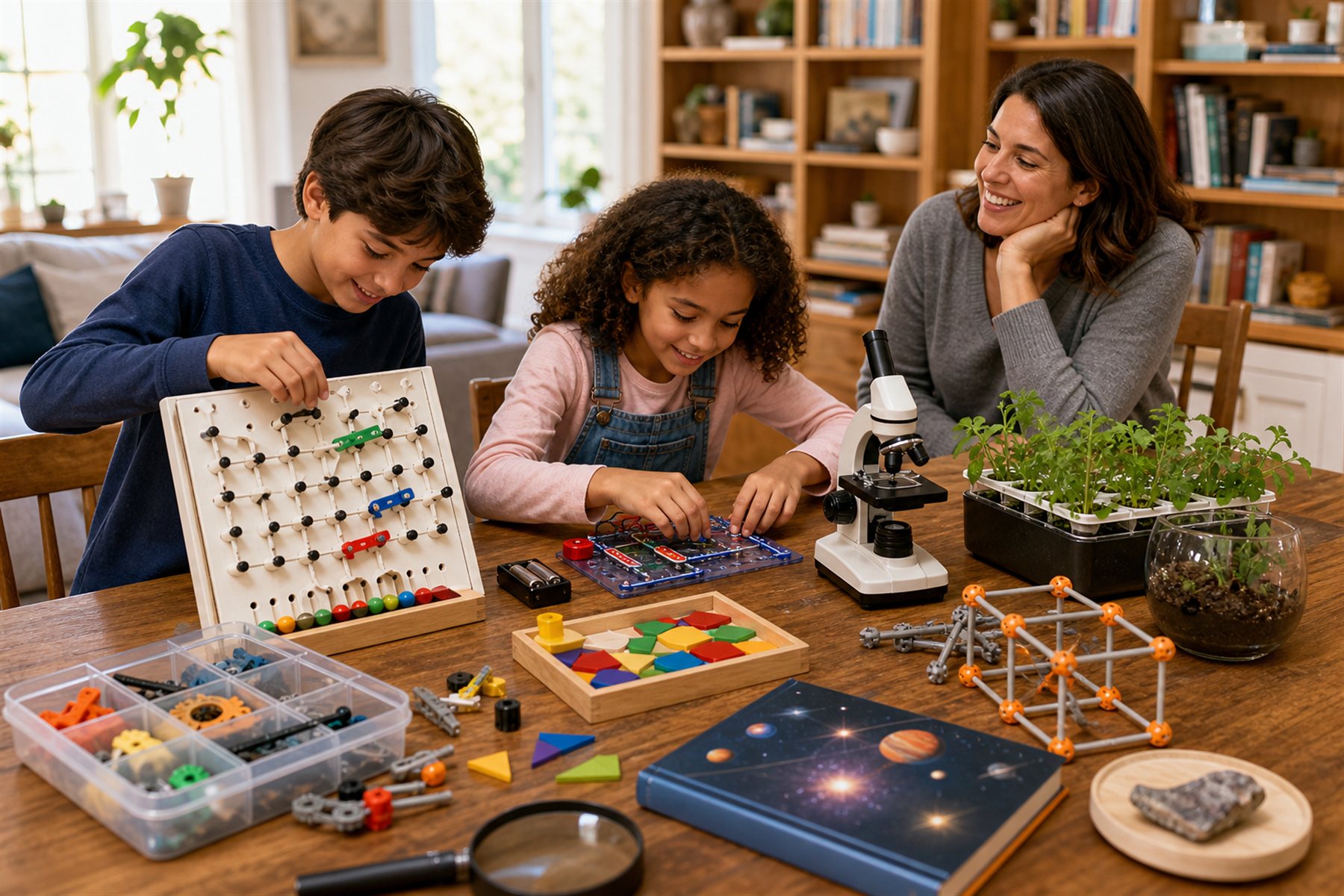
The best educational gift is not the one with the most impressive claims on the box. It is the thing a child pulls out again after the birthday excitement is over: the logic game that remains challenging, the microscope that actually focuses, the building set that does not dictate one correct result, or the book that gets quoted at dinner six months later.
This guide is for curious children, enthusiastic tinkerers, fact collectors, reluctant readers, young naturalists, puzzle solvers, and kids who simply enjoy figuring out how things work. “Brainy” does not have to mean advanced in every subject. Curiosity is enough.
Affiliate disclosure: As an Amazon Associate I earn from qualifying purchases. This page contains Amazon affiliate links. RingJing may earn a commission if you buy through them, at no additional cost to you. Recommendations and opinions remain our own.
How this guide is organized
Age ranges are approximate. A patient six-year-old may love a gift labeled for eight-year-olds, while a twelve-year-old may happily spend an afternoon with a building set marketed younger. Prices change too often to quote, so the symbols below are broad shopping tiers rather than promises.
- $ usually under $30
- $$ usually $30–$100
- $$$ usually above $100
Products and affiliate destinations were reviewed August 17, 2026. Check current age guidance, included parts, safety warnings, price, and availability before ordering.
The short version
If I were shopping in a hurry, I would start with Gravity Maze, Kanoodle, or IQ Puzzler Pro for a child who likes quiet challenges, Snap Circuits, Makey Makey, or a cyborg hand kit for a builder, and National Geographic Kids Almanac for a kid who collects facts the way other children collect stickers.
For a birthday, a gift also pairs nicely with an experience. You may also want RingJing’s guides to easy birthday party food, useful party favors, and free and cheap things to do with kids in Central Maryland.
Ten gifts I would check first
| Gift | Best fit | Cost |
|---|---|---|
| Gravity Maze | Solo logic and spatial reasoning, ages 8+ | $ |
| Snap Circuits | Hands-on electronics, roughly ages 8+ | $$ |
| Prime Climb | Family math game, ages 10+ | $ |
| Makey Makey | Inventors who enjoy computers, ages 8+ | $$ |
| Turing Tumble | Mechanical computing and logic, ages 8+ | $$ |
| Rock tumbler | Patient geology fans, ages 8+ | $$ |
| Butterfly garden | Life cycles and observation, ages 4+ | $ |
| AmScope compound microscope | Serious young scientists with adult help | $$$ |
| National Geographic Kids Almanac | Fact collectors and browsers, ages 7+ | $ |
| Yoto Mini | Screen-free stories, music, and audio | $$ |
Educational gifts for preschoolers and younger children
1. Pengoloo memory game
 Pengoloo is a wooden memory game with enough luck to keep adults from automatically winning. Children practice color recognition, turn-taking, and remembering where the hidden eggs are. Best for: ages 3–6. Cost: $.View on AmazonAffiliate link; check current price, age range, and availability.
2. Magnetic construction pieces
 Magformers and similar magnetic construction systems make geometry tangible. Start with enough pieces to build something larger than a frustrated little cube. Best for: ages 3+. Cost: $$.View on AmazonAffiliate link; check current price, age range, and availability.
3. Gears building set
 A gears building set gives younger children an immediate cause-and-effect payoff. One gear turns, another moves, and suddenly the whole table is machinery. Look for large pieces appropriate to the child’s age. Best for: ages 3–7. Cost: $$.View on AmazonAffiliate link; check current price, age range, and availability.
4. Periodic table blocks
 Periodic table building blocks are mostly ordinary blocks at first, and that is fine. As children grow, the element names and symbols become familiar rather than intimidating. Best for: ages 2+ with age-appropriate block size. Cost: $$.View on AmazonAffiliate link; check current price, age range, and availability.
5. Educational placemats
 Maps, alphabets, planets, insects, and multiplication placemats are inexpensive background learning. Children absorb surprising amounts from something that remains on the table for a year. Best for: ages 2–8. Cost: $.View on AmazonAffiliate link; check current price, age range, and availability.
6. BugLoupe
 The Carson BugLoupe lets a child examine a temporary insect visitor from above and below. It offers more immediate success than a cheap toy microscope. Release living creatures promptly and gently. Best for: ages 4–8. Cost: $.View on AmazonAffiliate link; check current price, age range, and availability.
7. Terrarium kit
 A small terrarium kit combines a craft project with plant observation. The educational value improves considerably if the child waters it instead of handing maintenance to an adult on day three. Best for: ages 5+. Cost: $.View on AmazonAffiliate link; check current price, age range, and availability.
8. Globe or inflatable globe
 A standard globe invites spontaneous geography questions. An inflatable write-on globe is less elegant but more forgiving for young children. Best for: ages 4+. Cost: $–$$.View on AmazonAffiliate link; check current price, age range, and availability.
Science and engineering gifts for elementary children
9. Gravity Maze
 Gravity Maze asks a child to arrange towers so a marble reaches its target. The challenges grow gradually, and the answer is physical: either the marble travels through the maze or it does not. Best for: ages 8+. Cost: $.View on AmazonAffiliate link; check current price, age range, and availability.
10. Snap Circuits
 Snap Circuits lets children build working electronic projects without soldering. The diagrams make early success possible, while the parts leave room for experimentation later. Choose the kit size based on patience as much as budget. Best for: ages 8+. Cost: $$.View on AmazonAffiliate link; check current price, age range, and availability.
11. Makey Makey
 With Makey Makey, bananas, foil, pencil drawings, and other conductive objects can become computer controls. The kit is at its best when a child invents a purpose rather than completing one prescribed project. Best for: ages 8+. Cost: $$.View on AmazonAffiliate link; check current price, age range, and availability.
12. Turing Tumble
 Turing Tumble teaches computing ideas with ramps, switches, and marbles instead of a screen. Children physically build solutions to increasingly complex logic problems. Best for: ages 8+. Cost: $$.View on AmazonAffiliate link; check current price, age range, and availability.
13. Circuit Maze
 Circuit Maze combines a single-player logic game with simple electrical circuits. It is more puzzle than open-ended electronics kit, which suits children who like clear challenges. Best for: ages 8+. Cost: $.View on AmazonAffiliate link; check current price, age range, and availability.
14. ChompSaw cardboard cutter
 The ChompShop ChompSaw is a kid-focused power tool for cutting cardboard into prototypes, costumes, structures, signs, and inventions. It is expensive compared with ordinary craft tools, but it can be a terrific gift for a child who constantly turns shipping boxes into projects. The cutting design is intended to be safer than conventional saws, but families should still follow the manufacturer’s current age guidance, setup instructions, and supervision recommendations. Best for: committed young makers and cardboard engineers. Cost: $$$.View on AmazonAffiliate link; check current price, age range, and availability.
15. Mechanical cyborg hand
 A build-your-own hydraulic cyborg hand is a satisfying middle ground between model kit and wearable machine. Expect careful assembly and adult help for some children. Best for: ages 10+. Cost: $$.View on AmazonAffiliate link; check current price, age range, and availability.
16. Crystal growing kit
 A crystal growing kit rewards careful measurement and patience. This is chemistry, not edible candy, so follow the safety instructions and supervise the process. Best for: ages 8+ with adult involvement. Cost: $.View on AmazonAffiliate link; check current price, age range, and availability.
17. Break-your-own geodes
 Break-your-own geodes bring a little useful suspense to geology. Use eye protection, contain the fragments, and discuss why the interior formed differently from the outside. Best for: ages 6+ with adult supervision. Cost: $.View on AmazonAffiliate link; check current price, age range, and availability.
18. Rock tumbler
 A rock tumbler is not a one-afternoon project. It is noisy, slow, and excellent for a child who can follow a process over several weeks. Put it somewhere the family does not sleep. Best for: ages 8+. Cost: $$.View on AmazonAffiliate link; check current price, age range, and availability.
19. Candy chemistry
 Candy Chemistry uses sweets to introduce temperature, crystallization, and changes in matter. Adult participation is important because the project may involve hot mixtures. Best for: ages 10+. Cost: $$.View on AmazonAffiliate link; check current price, age range, and availability.
20. Mushroom growing kit
 An oyster mushroom kit grows quickly enough to hold a child’s attention and makes fungi feel considerably more interesting than a paragraph in a textbook. Follow the seller’s food-safety directions. Best for: ages 7+. Cost: $.View on AmazonAffiliate link; check current price, age range, and availability.
21. AeroGarden or countertop hydroponics
 A countertop hydroponic garden turns plant growth into something children can measure and eventually eat. It is pricier than a pot of soil, but indoor lighting makes results more predictable. Best for: ages 8+ or a family project. Cost: $$–$$$.View on AmazonAffiliate link; check current price, age range, and availability.
Puzzles, math games, and smart family games
22. Prime Climb
 Prime Climb is one of the rare math games that feels like a real strategy game. Color coding helps players see multiplication and factor relationships. Best for: ages 10+ and adults. Cost: $.View on AmazonAffiliate link; check current price, age range, and availability.
23. The 24 Game
 The 24 Game asks players to combine four numbers to make 24 using arithmetic operations. It strengthens number flexibility without another sheet of equations. Best for: roughly ages 8+. Cost: $.View on AmazonAffiliate link; check current price, age range, and availability.
24. Quoridor
 Quoridor has simple rules: reach the opposite side while placing walls to slow everyone else. The strategy deepens quickly, but a full game does not consume an evening. Best for: ages 6+. Cost: $.View on AmazonAffiliate link; check current price, age range, and availability.
25. Laser Maze
 Laser Maze uses mirrors and logic challenges to direct a low-power laser toward a target. It is a satisfying solo puzzle for children who enjoy arranging physical pieces. Follow the included laser-safety directions. Best for: ages 8+. Cost: $.View on AmazonAffiliate link; check current price, age range, and availability.
26. Perplexus
 A Perplexus maze requires a player to rotate a clear sphere while guiding a small ball through a three-dimensional obstacle course. It develops patience along with spatial reasoning. Best for: ages vary by model. Cost: $.View on AmazonAffiliate link; check current price, age range, and availability.
27. Kanoodle
 Kanoodle is compact, portable, and full of two- and three-dimensional spatial puzzles. It is the sort of gift that can live in a travel bag instead of requiring its own shelf. Best for: ages 7+. Cost: $.View on AmazonAffiliate link; check current price, age range, and availability.
28. Shashibo shape-shifting cube
 A Shashibo cube folds into many geometric forms using internal magnets. It is part fidget, part spatial puzzle, and more interesting when several cubes are combined. Best for: ages 8+. Cost: $.View on AmazonAffiliate link; check current price, age range, and availability.
29. Chess set and a child-friendly guide
 Pair a wooden chess set with a book that teaches chess. A beautiful board does not teach the game by itself, and an app is not the only route. Best for: ages 6+. Cost: $–$$.View on AmazonAffiliate link; check current price, age range, and availability.
Books for children who collect facts and ideas
30. Ken Jennings Junior Genius Guides
 The Junior Genius Guides cover subjects such as maps, mythology, presidents, space, and the human body with humor and memorable side facts. They are especially good for children who prefer browsing to reading straight through. Best for: ages 7–11. Cost: $.View on AmazonAffiliate link; check current price, age range, and availability.
31. National Geographic Kids Almanac
 The annual National Geographic Kids Almanac is dense with short facts, photographs, maps, animals, science, and current topics. Some children nibble at it; others disappear with it. Best for: ages 7–12. Cost: $.View on AmazonAffiliate link; check current price, age range, and availability.
32. Greg Tang math books
 Greg Tang’s math books use visual puzzles and clever grouping to help children see numbers differently. They work well for a child who is capable at math but tired of conventional practice. Best for: ages 5–10. Cost: $.View on AmazonAffiliate link; check current price, age range, and availability.
33. Perplexors logic puzzle books
 Perplexors use clues, grids, and deduction. Select the level carefully; a logic book that is far too hard becomes a very thin doorstop. Best for: roughly ages 8+ depending on level. Cost: $.View on AmazonAffiliate link; check current price, age range, and availability.
34. Blank books for young authors
 A set of blank books gives a child a finished object rather than another pile of loose drawings. Pair them with good pens and resist becoming the editor. Best for: ages 5–10. Cost: $.View on AmazonAffiliate link; check current price, age range, and availability.
Gifts for older kids and teens
35. A microscope worth keeping
 Very cheap microscopes often create more frustration than discovery. The AmScope B100B-MS is a more serious compound microscope for a child ready to learn slide preparation and focusing. It is a family investment, not a toy-bin purchase. Best for: older elementary through high school with help. Cost: $$$.View on AmazonAffiliate link; check current price, age range, and availability.
36. Phone microscope attachment
 A phone microscope attachment is less capable than a laboratory microscope but far more portable. Children can inspect fabric, leaves, printed dots, insects, and household materials while saving photographs. Best for: ages 8+. Cost: $.View on AmazonAffiliate link; check current price, age range, and availability.
37. Beginner telescope
 A telescope can be wonderful, but the first gift should include realistic expectations and help finding the moon. The Celestron PowerSeeker 127EQ is one option from the original guide; compare current reviews and setup requirements before choosing it or another beginner model. Best for: ages 10+ with adult help. Cost: $$$.View on AmazonAffiliate link; check current price, age range, and availability.
38. Raspberry Pi starter kit
 Because Raspberry Pi models and bundles change, start with a current Raspberry Pi starter kit that includes the board, power supply, storage, case, and a beginner guide. This gift needs a project and sometimes a patient adult. Best for: ages 11+. Cost: $$–$$$.View on AmazonAffiliate link; check current price, age range, and availability.
39. 3Doodler Start+
 A low-temperature 3D printing pen designed for children lets a child draw structures in three dimensions without managing a full printer. Buy extra compatible material if the first weekend is likely to be enthusiastic. Best for: ages 6+ per current manufacturer guidance. Cost: $$.View on AmazonAffiliate link; check current price, age range, and availability.
40. Entry-level 3D printer
 A beginner 3D printer is really a family workshop tool. Expect calibration, software learning, failed prints, hot components, and maintenance. For the right teen or parent-child team, those complications are part of the education. Best for: teens or younger children with close adult leadership. Cost: $$$.View on AmazonAffiliate link; check current price, age range, and availability.
41. Rocketbook reusable notebook
 A Rocketbook Fusion is practical for a student who enjoys organizing notes digitally. It is not exciting for every child, but the right middle-school, high-school, or college student may use it daily. Best for: ages 12+. Cost: $$.View on AmazonAffiliate link; check current price, age range, and availability.
42. Walkie-talkies
 Walkie-talkies teach practical communication, planning, and the limitations of radio range. Advertised distances usually assume ideal conditions, so do not promise communication across half the county. Best for: ages 7+. Cost: $$.View on AmazonAffiliate link; check current price, age range, and availability.
43. Beginner mini drone
 A small beginner drone develops orientation, fine control, and persistence. Start indoors only if the model is designed for it, protect people and pets, and learn current flight rules before moving to larger outdoor drones. Best for: ages 8+ with supervision. Cost: $–$$.View on AmazonAffiliate link; check current price, age range, and availability.
Experience gifts and subscriptions
If the gift is for a birthday rather than a holiday, RingJing’s guide to kids’ birthday party places in Howard County can help match the celebration to the child’s interests too.
44. KiwiCo crate
 A KiwiCo subscription or individual crate can be a good fit when the giver wants to supply a project without choosing every component. Match the line to the child’s age and interests rather than assuming the oldest-looking crate is best.
45. CrunchLabs Build Box
 The CrunchLabs Build Box combines engineering builds with video guidance. It suits children who enjoy energetic explanations and making a working mechanism. Consider storage before committing to a long subscription.
46. Museum or science-center membership
 A membership removes the pressure to “get your money’s worth” in one exhausting visit. Families can stay for an hour, revisit favorite exhibits, and leave before everyone dissolves. Look at reciprocal benefits and parking costs as well as admission.
47. Class, workshop, or camp credit
 Consider a pottery lesson, coding workshop, nature program, woodworking class, telescope night, cooking class, or maker-space session. Check scheduling with the parent first. An experience that expires on an impossible Tuesday is not much of a gift.
48. A project day with an adult
 Give the supplies and a dated invitation to build the robot, visit the museum, learn chess, cook the candy, or identify stars together. Many educational gifts fail because the child actually received a box of future adult obligations.
49. FamZoo account funding
 For a child ready to practice budgeting, a funded family finance account can teach more than another object. Read RingJing’s FamZoo review, or try FamZoo through our referral link. FamZoo is a financial tool, not an Amazon product.
50. Screen-free audiobook player
 A Yoto Mini or another screen-free audio player can give children independent access to stories, music, podcasts, and educational audio. Remember that the ongoing card or content cost is part of the gift. Best for: roughly ages 3–12. Cost: $$.View on AmazonAffiliate link; check current price, age range, and availability.
51. A child-controlled project budget
 Give a modest budget and help the child design the project: build a birdhouse, start a windowsill garden, make a stop-motion film, assemble a weather station, or create a tiny free library. Planning, tradeoffs, and revising the idea are part of the learning.
52. BBC micro:bit starter kit
 A BBC micro:bit starter kit is a good bridge between block coding and physical computing. Kids can make a step counter, temperature display, game controller, wearable badge, or simple sensor project without starting from a blank laptop screen. Best for: ages 8+ with some adult setup. Cost: $$.View on AmazonAffiliate link; check current price, age range, and availability.
53. Osmo Genius Starter Kit
 An Osmo Genius Starter Kit can work well for a child who likes tablet play but benefits from moving real pieces around. Check the current device compatibility before buying; the right kit depends on the tablet your family already owns. Best for: early elementary ages. Cost: $$.View on AmazonAffiliate link; check current price, age range, and availability.
54. Sphero indi or beginner coding robot
 Sphero indi and similar screen-light coding robots let children experiment with sequencing and cause-and-effect before formal programming. It is a nice choice for kids who want to drive something around the floor rather than stare at code. Best for: roughly ages 4-8. Cost: $$.View on AmazonAffiliate link; check current price, age range, and availability.
55. Botley coding robot
 Botley is another beginner coding robot that uses commands, obstacles, and simple challenges. It is most successful when the adult resists fixing every mistake and lets the child debug the route. Best for: ages 5+. Cost: $$.View on AmazonAffiliate link; check current price, age range, and availability.
56. Code & Go Robot Mouse
 The Code & Go Robot Mouse is a friendly first step into sequencing, direction, and debugging. It is less intimidating than a robotics kit and more hands-on than a coding app. Best for: preschool and early elementary kids. Cost: $-$$.View on AmazonAffiliate link; check current price, age range, and availability.
57. LEGO robotics or SPIKE-style kit
 A LEGO robotics kit is expensive, but it can be the right gift for a child who already builds constantly and wants motors, sensors, and programmable behavior. Check the exact kit, software requirements, replacement parts, and age guidance before buying. Best for: serious builders and robotics-club kids. Cost: $$$.View on AmazonAffiliate link; check current price, age range, and availability.
58. ThinkFun Hacker or cybersecurity puzzle game
 A cybersecurity-themed logic game can be a clever choice for a kid who likes secret codes, mazes, computers, or strategy puzzles. It is not a full coding course, but it makes networks and logic feel tangible. Best for: ages 10+. Cost: $-$$.View on AmazonAffiliate link; check current price, age range, and availability.
Five more Amazon ideas worth checking
These are not must-buys for every family. They are the kinds of gifts I would put on a maybe list when a child already has the obvious science kit, chess set, and marble maze.
59. SmartGames IQ Puzzler Pro
 SmartGames IQ Puzzler Pro is a small travel logic puzzle with many challenges packed into a case. It is good for car rides, waiting rooms, and the child who likes solving something alone before anyone else offers hints. Best for: ages 6+. Cost: $.View on AmazonAffiliate link; check current price, age range, and availability.
60. ThinkFun Roller Coaster Challenge
 Roller Coaster Challenge turns gravity, sequencing, and trial-and-error into a puzzle. It has more motion than a flat logic game, which can help kids who need to see the result before they care about the reasoning. Best for: ages 6+. Cost: $$.View on AmazonAffiliate link; check current price, age range, and availability.
61. Klutz LEGO Gear Bots
 Klutz LEGO Gear Bots is a nice pick for a LEGO kid who is ready to notice cams, cranks, axles, and moving parts. It feels more like making little mechanical creatures than completing a standard set. Best for: ages 8+. Cost: $$.View on AmazonAffiliate link; check current price, age range, and availability.
62. Thames & Kosmos Architectural Engineering
 Thames & Kosmos Architectural Engineering is for the child who asks why bridges stand up, why towers sway, or why some buildings look impossible. It is more methodical than flashy, which is exactly the point. Best for: ages 8+ to 12+ depending on patience. Cost: $$.View on AmazonAffiliate link; check current price, age range, and availability.
63. National Geographic dino fossil dig kit
 A dinosaur fossil dig kit can be messy in the best possible way. Give it with a tray, a table covering, and permission to go slowly. The digging is usually the learning, not just the thing found at the end. Best for: ages 6+ with cleanup tolerance. Cost: $.View on AmazonAffiliate link; check current price, age range, and availability.
How to choose without buying educational clutter
- Buy for the child in front of you. A robotics kit is not automatically better than a drawing book.
- Count the hidden adult time. Assembly, troubleshooting, live animals, subscriptions, and app setup may become someone else’s job.
- Prefer depth over a giant piece count. More parts do not guarantee more thought.
- Check replacement supplies. Find out whether the gift requires proprietary refills, cards, filament, chemicals, specimens, or batteries.
- Take age labels seriously when safety is involved. Chemicals, lasers, magnets, projectiles, drones, tools, and small parts require judgment beyond academic ability.
- Leave room for ordinary fun. A gift can teach persistence or imagination without announcing itself as STEM.
Pair the gift with somewhere to use the curiosity
RingJing’s guide to Maryland educational field trips includes science centers, nature programs, historical sites, and museums. A microscope becomes more interesting after a pond visit; a geology kit lands differently after seeing a real collection.
Frequently asked questions
What is a good educational gift for a child who already has many toys?
Choose a consumable project, experience, membership, advanced book, puzzle series, or upgrade to a tool the child already uses. Avoid another large kit unless it adds a genuinely new capability.
What are the best STEM gifts for kids?
Strong general choices include Snap Circuits, Gravity Maze, Makey Makey, Turing Tumble, a quality microscope, a rock tumbler, engineering construction sets, and carefully selected science kits. The best option matches the child’s interests and tolerance for instructions, frustration, and adult help.
What are inexpensive educational gift ideas?
Consider the 24 Game, Perplexors, educational placemats, a BugLoupe, geodes, a blank book, a National Geographic Kids Almanac, seeds, a logic puzzle, or a child-friendly chess guide.
What is a good educational gift for a gifted child?
Do not focus only on a higher age label. Look for open-ended tools, deeper challenges, unusual nonfiction, authentic equipment, creative projects, and experiences connected to the child’s strongest interests. Gifted children still need play, choice, and room to be beginners.
Are subscription boxes worth it?
They can be worthwhile when the child completes projects and the family has storage and time. Try one crate or a short subscription before committing to a year. A growing stack of unopened educational boxes is not educational.
How do Amazon affiliate links affect this guide?
RingJing may earn a commission from qualifying Amazon purchases made through marked links, without increasing the buyer’s price. Affiliate relationships do not change the editorial criteria, and readers should compare current products, sellers, safety information, and prices before purchasing.